
Welfare for gratitude? Assam govt asks Orunodoi, PMAY beneficiaries to light lamps for Modi




Guwahati: A month-long government campaign in Assam to commemorate Prime Minister Narendra Modi’s 25 years of public service has triggered questions over the use of beneficiaries of government welfare schemes for an exercise of public gratitude towards a political leader
The directive is part of the Assam government’s programme “Seva Sankalp Abhiyan”, being organised from September 17 to October 17 to commemorate 25 years of public service of Prime Minister Modi.
Northeast Now has accessed the executive order issued by Assam Chief Secretary Ravi Kota pursuant to directions of Chief Minister Himanta Biswa Sarma. The order states that Sarma gave the directions at a meeting held on September 7 in the presence of Cabinet ministers and senior government officers.

Under the Assam government’s executive order on the “Seva Sankalp Abhiyan”, a the programme titled “Ashirwad Ka Diya”, (The Lamp of Blessing), calls for lamps to be lit at 7 PM on September 17 in the households of beneficiaries under four major welfare schemes — Orunodoi, PMAY-Gramin, PMAY-Urban, and Ration Card holders — as, in the order's own words, "an expression of gratitude and public blessings" for "25 years of dedicated public service of the Hon'ble Prime Minister."
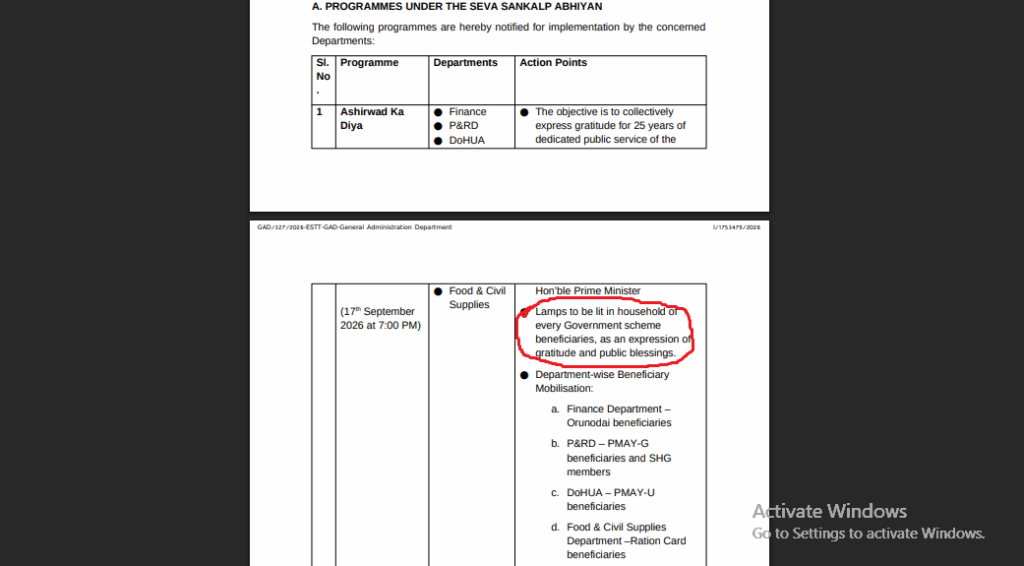
“Lamps to be lit in household of every Government scheme beneficiaries, as an expression of gratitude and public blessings,” the executive order states.
The Assam government has gone a step further by assigning specific departments to mobilise beneficiaries for the programme.
The Finance Department has been tasked with mobilising Orunodai beneficiaries, the Panchayat and Rural Development Department with PMAY-G beneficiaries and SHG members, the Department of Housing and Urban Affairs with PMAY-U beneficiaries, and the Food and Civil Supplies Department with ration-card beneficiaries.
A common call-centre mechanism is also to be established for mobilisation, coordination and monitoring.
But why should a welfare beneficiary light a lamp for a Prime Minister?
That is the question the Assam government’s order inevitably raises. Government welfare schemes are public programmes meant for eligible citizens. A person receiving financial assistance under Orunodai, a house under PMAY or subsidised food through a ration card receives a public entitlement subject to the rules of the scheme.
So, why is the government machinery being used to mobilise these beneficiaries to light lamps as an expression of gratitude to the Prime Minister?
The order does not explicitly state that a beneficiary will lose a government benefit for refusing to light a lamp. Nor does it expressly say that lighting the lamp is a legal condition for receiving any welfare scheme.
But that is not the only issue. The concern arises from the fact that the programme is not simply being left to individual citizens. Government departments have been specifically assigned beneficiaries to mobilise, while the campaign itself is backed by district administrations and senior officials.
The order directs administrative departments to issue instructions to their field formations and ensure uniform implementation across districts. District Commissioners have been made the overall coordinating authorities for the campaign.
It also requires senior secretaries and District Commissioners to update the progress of the campaign daily to the Chief Secretary and the Chief Minister’s Office.
That makes “Ashirwad Ka Diya” more than a symbolic suggestion from the government. It is embedded in an administrative exercise involving departments, beneficiaries, district officials, mobilisation and monitoring.
When welfare becomes a vehicle for gratitude
The choice of beneficiaries is particularly significant. The government has specifically identified people receiving Orunodai, PMAY, SHG and ration-card benefits for mobilisation. These are citizens who are among the direct recipients of state welfare interventions.
The question, therefore, is not whether citizens should be allowed to celebrate the Prime Minister. They are free to do so.
The question is whether the state government should use its administrative machinery to organise gratitude among beneficiaries of government schemes towards a political leader.
There is a fundamental difference between telling citizens that a lamp-lighting event is open to everyone and directing departments to mobilise identified welfare beneficiaries.
The phrase “public blessings” in an official government order makes that distinction even more striking.
Is a welfare benefit a favour?
The symbolism of “Ashirwad Ka Diya” also raises a larger question about how welfare is being presented.
A government scheme is not a personal gift from an elected leader. It is implemented through public institutions and financed through public resources. Citizens become beneficiaries because they meet eligibility requirements prescribed under a scheme—not because they owe political gratitude to anyone.
Yet the Assam government’s order places welfare beneficiaries at the centre of an exercise explicitly designed to express gratitude for Prime Minister Modi’s 25 years of public service.
The government says the wider campaign is about public service, welfare, empowerment and last-mile delivery. But “Ashirwad Ka Diya” introduces a distinctly political-personal element into that administrative exercise.
Government machinery for political commemoration?
The executive order lists several other activities under the month-long campaign. Under “Seva Ki Kahani”, government departments have been instructed to create reels, videos and photographs featuring beneficiaries of schemes such as Orunodai, PMAY and SHGs, documenting their experiences and the impact of government programmes for dissemination through official social media platforms.
The campaign also includes public participation programmes, torch and mashaal processions, a proposed permanent Akhand Jyoti in Guwahati and a collective “Sankalp for Viksit Bharat 2047”.
The scale of the administrative involvement is considerable. And that is precisely why “Ashirwad Ka Diya” deserves scrutiny beyond the symbolism of a lamp.
A lamp lit voluntarily by a citizen is an expression of personal choice. A lamp lit after a government department has been tasked with identifying and mobilising beneficiaries is something altogether different.
The executive order does not establish that beneficiaries will be punished for not participating. But it does establish that the state machinery will be used to mobilise them.
The question Assam must answer is simple: are citizens receiving welfare because they are entitled to it as citizens—or are they now expected to demonstrate gratitude for receiving it?
The answer matters because welfare delivery and political loyalty should not become interchangeable concepts.
“Ashirwad Ka Diya” may be presented as a lamp of blessings. But when the government itself asks welfare beneficiaries to light that lamp for a political leader, the issue is no longer merely about a diya. It is about the relationship between the citizen, the state and political power.